GST Appeal in the Bombay High Court
Writ Jurisdiction, the Statutory Appellate Hierarchy, and the Case Law of 2025–2026
Over the last eighteen months, the Bombay High Court — sitting at Mumbai, the Nagpur Bench, the Aurangabad Bench, and the Goa Bench — has emerged as one of the most active forums in the country for testing the boundaries of Article 226 writ jurisdiction against the statutory GST appellate hierarchy under Sections 107 and 112 of the CGST Act, 2017. The cases discussed below — drawn exclusively from Bombay High Court and Supreme Court rulings of 2025 and 2026 — illustrate where that aperture still opens, and where it firmly does not.
Part I — The Architecture of GST Appeals
1.1 The Statutory Ladder
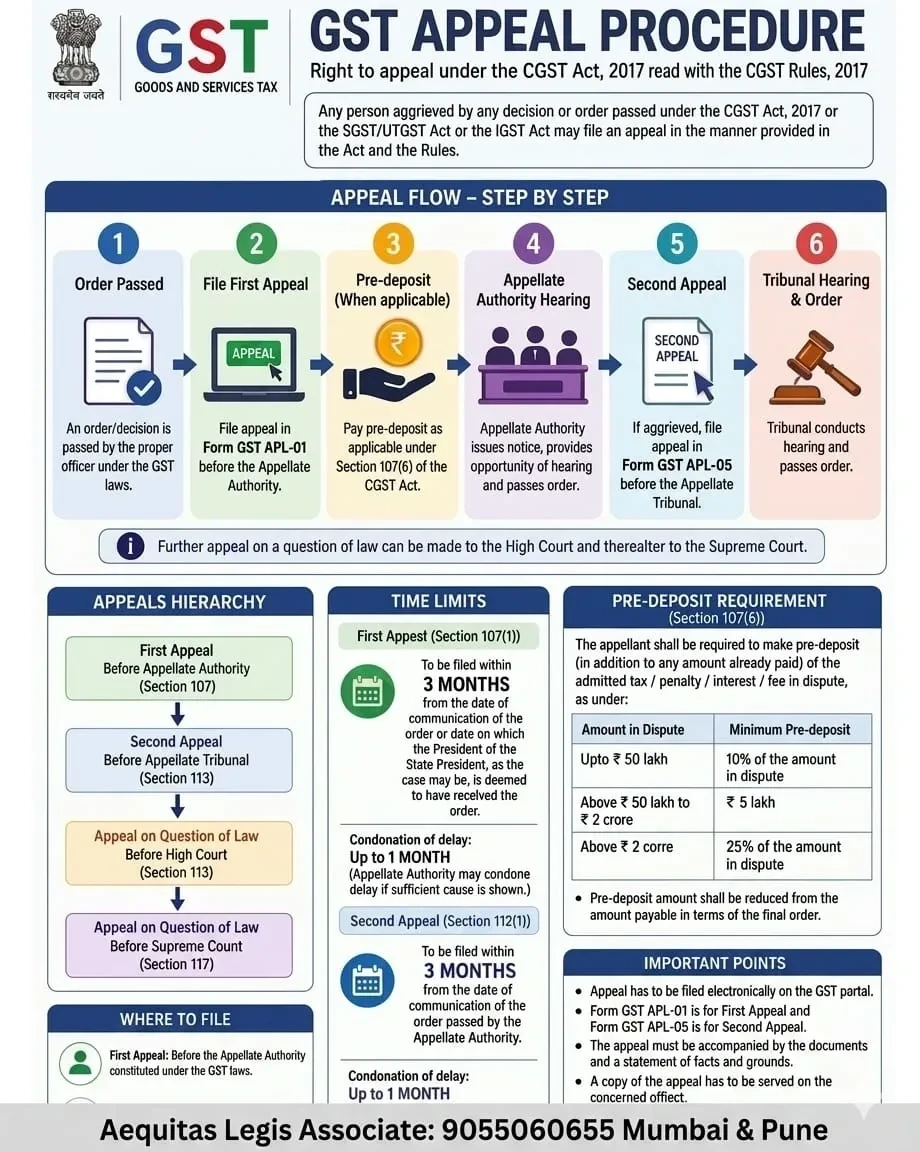
The CGST Act, 2017 prescribes a three-tier appellate structure:
- ▸Section 107 — First Appeal to the Appellate Authority, requiring a mandatory pre-deposit of 10% of the disputed tax (subject to the cap), filed within three months of the order, extendable by one month.
- ▸Section 112 — Second Appeal to the GST Appellate Tribunal (GSTAT), requiring an additional pre-deposit, exclusively through the Electronic Cash Ledger, subject to an aggregate cap.
- ▸Section 113 read with Section 117/118 — Further appeal to the High Court, but strictly confined to a "substantial question of law", and onward to the Supreme Court.
1.2 Where Article 226 Still Has Work To Do
Despite the Court's general reluctance to entertain merits-based writs, three categories continue to attract writ intervention as a matter of settled practice:
- ▸Want of jurisdiction — where the very foundation of the demand, such as the authority issuing the notice or the scope of the notice period, is legally unsustainable.
- ▸Breach of natural justice — denial of a fair hearing, inadequate notice periods, or non-application of mind.
- ▸Constitutional or vires challenges — to a notification, rule, or the levy itself, which no appellate authority below the High Court has the power to adjudicate.
Part II — Bombay High Court: The 2025–2026 Docket
1. Oberoi Constructions v. Union of India — (2025) 137 GSTR 601
This decision functions, in practical terms, as the doctrinal anchor for everything that follows. The Bench held that where a statutory appellate remedy under Section 107 exists and has not been shown to be illusory or ineffective, a writ petition assailing a GST assessment order on its merits ought ordinarily to be dismissed. The ruling is a reaffirmation — in the specific context of GST — of the long-settled administrative law principle that the existence of an adequate alternative remedy is a rule of self-imposed restraint on the writ court, not a bar to jurisdiction.
2. Arham Infra Developers AOP & Nirmite Buildtech v. Union of India — W.P. Nos. 8649 & 8650 of 2025
Two Nashik-based real estate developers, having received assessment orders on Joint Development Agreement (JDA) consideration, bypassed Section 107 entirely and approached the Bombay High Court directly. Yet the Bench, applying Oberoi Constructions, dismissed both petitions on the threshold question of maintainability. Recognising that the petitioners may have proceeded on bona fide legal advice, the Bench granted liberty to file statutory appeals within four weeks, directing that limitation objections not be raised if so filed.
3. Rithwik Projects Pvt. Ltd. v. Union of India & Ors. — Writ Petition No. 4061 of 2026
Here the writ succeeded — because the defect went to jurisdiction rather than merits. The Revenue had issued a single show cause notice seeking to recover approximately ₹2.54 crore spanning a period in excess of four financial years. A Division Bench held that a composite notice straddling multiple tax periods in this manner was without jurisdiction. The Revenue's defence — that the petitioner had an effective alternative remedy — was firmly rejected. The Bench restated the settled proposition that an order passed without jurisdiction is a nullity, incapable of being cured by waiver, acquiescence, or even an admission of liability.
4. Assignment of Leasehold Rights — WP No. 2145 of 2025 (Nagpur Bench) & Aerocom Cushions Pvt. Ltd. (January 2026)
On a substantive question of taxability, the Nagpur Bench held that GST is not leviable on the assignment of leasehold rights in an industrial plot. The Court drew a careful distinction between a lease (taxable under Schedule II, clause 2(b)) and an assignment of leasehold rights — characterised as a transfer of benefits arising out of immovable property, outside the scope of "supply" altogether. The show cause notice was quashed. Aerocom Cushions in January 2026 followed the same reasoning.
5. Matrix Cellular (International) Services Pvt. Ltd. — No Coercive Recovery Until the Appeal Window Closes
A Bench of Justices G.S. Kulkarni and Aarti Sathe addressed Revenue authorities initiating recovery proceedings before the statutory limitation period for filing an appeal had even expired. The Court held, in terms that practitioners should commit to memory, that premature recovery action renders the statutory right of appeal illusory. Accordingly, it restrained coercive recovery for a period of four weeks to allow the appeal to be filed before the GSTAT, while making clear that if no appeal was filed within that window, Revenue would be free to proceed.
6. Development Rights under Reverse Charge — Newlook Constructions & Nirmal Lifestyle Developers
In a cluster of tagged matters, the Bombay High Court admitted writ petitions challenging the levy of GST on the transfer of development rights under the reverse charge mechanism (RCM). Finding the issue squarely identical to an earlier admitted petition where interim relief had already been granted, the Court extended parity-based interim protection, including directions to the designated officer to recall bank account attachments within two weeks.
Part III — Supreme Court of India: The 2025–2026 Docket
1. Yasho Industries v. Union of India — decided 19 May 2025
The Supreme Court upheld the Gujarat High Court's decision permitting taxpayers to discharge the mandatory 10% pre-deposit under Section 107(6) using the balance available in their Electronic Credit Ledger (ECL) — that is, accumulated, unutilised Input Tax Credit — rather than insisting on cash payment through the Electronic Cash Ledger. This ruling materially lowers the entry cost of a Section 107 appeal for ITC-rich, cash-poor businesses. Note: the ruling is confined to the first-appeal pre-deposit; the GSTAT-stage pre-deposit under Section 112(8) must still be paid exclusively through the Electronic Cash Ledger.
2. State of Jharkhand v. BLA Infrastructure Pvt. Ltd. — decided 9 January 2026
The question was whether the limitation period under Section 54 applies to bar a delayed pre-deposit refund claim after a successful appeal. The Supreme Court affirmed that a pre-deposit refund is governed not by Section 54 at all, but by Section 107(6) read with Section 115 — the dedicated appellate-refund machinery. The Court's broader observation — that procedural timelines exist to facilitate the administration of the law, not to defeat a taxpayer's substantive, vested right to recover money paid solely to secure an appeal that has since succeeded — is expected to be cited extensively in refund litigation going forward.
3. The Open Question: Arham Infra Developers at the SLP Stage
The Supreme Court's interim stay in SLP (C) Nos. 26910/2025 and 27330/2025 keeps alive, at the highest level, the precise question this entire note has circled around: how far can Article 226 reach into GST disputes once a fully functional, merits-competent GSTAT exists? Clients with comparable JDA or development-rights exposure would be well advised to await this ruling — or to file protective appeals now — rather than betting on a favourable final outcome.
Part IV — Quick-Reference Table
| Case | Holding | Practical Effect |
|---|---|---|
| Oberoi Constructions (2025) | Writ dismissed where statutory remedy exists and is adequate. | Default rule: file Section 107 appeal first. |
| Arham Infra Developers (2025) | Writs on JDA/GST merits dismissed; liberty to appeal granted; SC stay pending. | Question of Art. 226 scope vs. GSTAT remains open at SC. |
| Rithwik Projects (2026) | Multi-year composite SCN held void for want of jurisdiction. | Audit SCNs for period-defects before choosing the forum. |
| Leasehold Assignment WP 2145/2025 | Assignment of leasehold rights is not a 'supply'. | Favourable, but Revenue's SLP at SC is pending. |
| Matrix Cellular (2026) | No coercive recovery before appeal limitation expires. | Use as shield against premature DRC-13 notices. |
| Yasho Industries (SC, 2025) | ECL/ITC can fund the Section 107(6) pre-deposit. | Eases cash-flow burden of filing first appeals. |
| BLA Infrastructure (SC, 2026) | Pre-deposit refunds governed by S.107(6)/115, not S.54 limitation. | Strengthens refund claims after a successful appeal. |
Part V — Concluding View
Three principles should guide any GST appellate strategy in Maharashtra today:
- Exhaust the statutory ladder unless the defect is jurisdictional, constitutional, or a clear breach of natural justice. The Bombay High Court's post-Oberoi Constructions jurisprudence treats the Section 107/112 route as the rule, not the exception, now that GSTAT benches are functioning.
- Audit every show cause notice for period and authority defects before filing. Rithwik Projects confirms that composite, multi-year notices remain vulnerable to a writ challenge regardless of the taxpayer's subsequent conduct.
- Use the pre-deposit and refund rulings to de-risk the appeal financially. Yasho Industries and BLA Infrastructure together mean that filing an appeal need neither drain cash reserves nor create a stranded asset if the appeal succeeds.
Finally, clients with live exposure on JDAs, development rights, or leasehold assignments should treat the pending Supreme Court matters — the Arham Infra Developers SLP and the Revenue's SLP against the Gujarat High Court's leasehold ruling — as the two dockets most likely to reshape this entire area of law before the end of 2026. Protective filings now remain the most prudent course.
AEQUITAS LEGIS ASSOCIATES | Advocates & Solicitors | Pune | Mumbai | Delhi
This note is prepared for general informational purposes only and does not constitute legal advice or a legal opinion on any specific matter. Readers should seek independent advice from qualified counsel before acting on any of the matters discussed.