
NRI Divorce in India: Jurisdiction, Foreign Decrees, Custody and Property Explained
Facing an NRI divorce? Here is what the law says in 2026.
When a marriage between Non-Resident Indians (NRIs) breaks down, the first question is often not "should we divorce?" but "where do we file — India or abroad?" The answer matters more than most people expect. A divorce that is perfectly valid in the US, UK or Canada can be treated as invalid in India. That can leave one spouse still married under Indian law, exposed to bigamy or maintenance proceedings, and unable to sell property as a single person.
1. Which Law Applies, and on What Grounds?
Divorce for NRIs follows the same legal framework as for residents of India. Living abroad does not change the personal law that governs your marriage. It adds questions of jurisdiction, enforcement and, often, a foreign court.
- Hindus, Sikhs, Jains and Buddhists: Hindu Marriage Act, 1955 (HMA)
- Interfaith couples and civil marriages: Special Marriage Act, 1954 (SMA)
- Muslims and Christians: their own personal laws and statutes
Two routes to divorce
Mutual consent (Section 13B HMA, Section 28 SMA)
Both spouses agree and have lived separately for at least a year.
Contested divorce (Section 13 HMA, Section 27 SMA)
One spouse petitions on a legal ground and must prove it with evidence. Common grounds include cruelty, adultery, desertion for at least two years and, under the HMA, conversion to another religion.
Muslim marriages are governed by Muslim personal law and the Dissolution of Muslim Marriages Act, 1939. Instant triple talaq was declared invalid by the Supreme Court in 2017 and is a punishable offence under the Muslim Women (Protection of Rights on Marriage) Act, 2019. Christian couples are governed by the Indian Divorce Act, 1869, and petitions are heard by the district court on statutory grounds such as adultery, cruelty and desertion.
2. Where Can an NRI File for Divorce?
In India
A petition can generally be filed in the family court where the marriage was solemnised, where the couple last lived together, or where the other spouse lives. A wife can also file where she lives. Indian courts have a clear basis to hear a case when the marriage took place in India or at least one spouse lives here.
Abroad
If the marriage took place overseas or both spouses live abroad, an NRI can also approach a court in the country of residence, subject to that country's laws. A foreign decree is not automatically valid in India.
When both spouses live abroad
If both spouses live abroad, jurisdiction gets tricky. Some Indian courts decline such cases. Others hear them where there are sufficient ties to India, such as a wedding here or earlier residence here. Take legal advice before filing.
Many NRIs choose to file in India, particularly where the marriage was solemnised here or Indian assets are involved. An Indian decree avoids the recognition problems described below.
3. How the Process Works in India
Petition
The petitioner drafts and files the divorce petition in the family court.
Summons
The other spouse is served and asked to respond.
Mutual consent
Both spouses appear to confirm their consent, then wait out a six-month cooling-off period before the divorce is finalised. Courts can waive this period in exceptional cases.
Contested cases
The court holds a trial with evidence and hearings, which can take years depending on complexity.
Decree
The court passes a decree of divorce, which legally ends the marriage.
4. Will India Recognise a Foreign Divorce Decree?
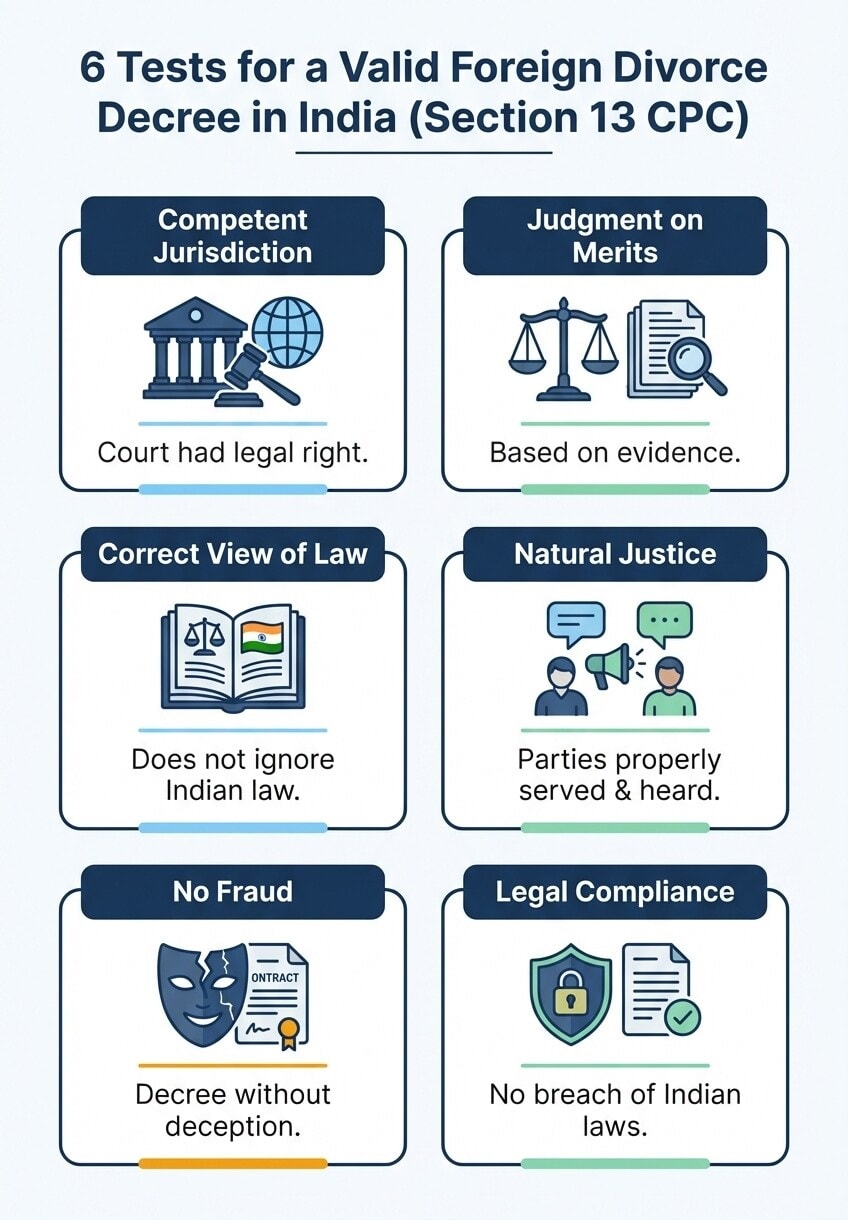
This is the most important question for NRIs, and the answer is: not automatically. A foreign decree is valid in India only if a court of competent jurisdiction issued it and it does not offend Indian law. Section 13 of the Code of Civil Procedure, 1908 (CPC) sets the test for when a foreign judgment is conclusive.
A foreign divorce decree will be rejected if:
Competent Jurisdiction
The court lacked competent jurisdiction. This is usually judged by the parties' domicile or residence.
Judgment on Merits
It was not decided on the merits — for example, a default judgment because one spouse did not appear.
Correct View of Law
It rests on a wrong view of the law — an incorrect view of international law, or a refusal to recognise applicable Indian law such as the HMA.
Natural Justice
Natural justice was breached — a spouse was not properly served or given a fair chance to be heard.
No Fraud
It was obtained by fraud, including deception or withholding material facts from the foreign court.
Legal Compliance
It breaches Indian law — it sustains a claim founded on a breach of a law in force in India.
The leading authority is the Supreme Court's 1991 ruling in Y. Narasimha Rao v. Y. Venkata Lakshmi. The Court applied the same test again in 2026 in Kishorekumar Mohan Kale v. Kashmira Kale, where a US divorce on the ground of irretrievable breakdown was held not binding in India because that ground does not exist under the HMA and the husband had not submitted to the US court's jurisdiction. The Court then used its powers under Article 142 to grant a divorce itself.
Warning
A decree that fails these tests is treated as null and void in India. In the eyes of Indian law the spouses remain married, and a remarriage can lead to bigamy charges.
How to get a foreign decree recognised
To get a foreign decree recognised, file a petition for recognition or execution in an Indian family court. If the foreign country has a reciprocating arrangement with India, the decree can be executed as if an Indian court had passed it. If not, a fresh suit based on the foreign judgment is needed.
5. US Law vs Indian Law: Key Differences
Many NRIs live in the US, where family law differs sharply from Indian law. The comparison below shows why the choice of forum matters so much.
| Issue | US Law | Indian Law |
|---|---|---|
| Basis for divorce | No-fault in every state: one spouse can end the marriage by citing irreconcilable differences, with no need for the other's consent. | Mutual consent (Section 13B HMA), or a contested petition where a ground such as cruelty, adultery or desertion must be proved. |
| Living together | No equivalent of forcing a spouse to return; courts prioritise individual liberty. | Restitution of conjugal rights (Section 9 HMA): if the spouse does not return for a year after the court's order, that becomes a ground for divorce. |
| Property | Marital assets including retirement accounts are shared. Community-property states split them equally; others use equitable distribution. | No general matrimonial-property regime: property usually belongs to whoever holds the title; streedhan belongs solely to the wife; relief comes through alimony rather than a 50-50 split. |
| Spousal support | Gender-neutral: a higher-earning spouse may have to pay. Child support follows income-based formulas. | Maintenance under HMA Sections 24 and 25 and BNSS Section 144, mainly for wives, children and parents. |
| Child custody | Joint legal custody is common; taking a child abroad without the other parent's consent can be treated as abduction. | Child's welfare is paramount; children under five are ordinarily with the mother; usually one parent gets primary custody and the other visitation rights. |
| Domestic violence | Police act immediately on a 911 call and restraining orders can follow, with serious immigration consequences. | Protection of Women from Domestic Violence Act, 2005, plus strict dowry-harassment laws. |
6. Custody, Property and Maintenance Across Borders
Child custody
Foreign custody orders do not automatically bind Indian courts. Indian courts act as the ultimate guardian of the child and put the child's welfare above any foreign arrangement. Parents who want a foreign order followed in India often seek a mirror order from an Indian court. India is not a signatory to the Hague Convention on international child abduction, so these cases are decided under Indian domestic law.
Property
Indian courts have exclusive jurisdiction over immovable property in India. A foreign court cannot order the transfer of a flat in Delhi or a farm in Punjab. Bank accounts and investments held in India also remain subject to Indian succession and matrimonial laws. Expect to need separate proceedings in India to settle Indian property.
Alimony and maintenance
Courts can order maintenance for a spouse whether they live in India or abroad. Enforcing an order against a spouse overseas can be difficult and may need international enforcement mechanisms. Where a foreign award is far below what Indian standards would require, an Indian court may in appropriate cases grant additional maintenance under Indian law.
Immigration and travel
Custody and property disputes can also complicate visa and immigration status, particularly if one spouse uses the proceedings to restrict the other's movement. Raise this with your lawyer early.
7. The Race to the Courthouse: Anti-Suit Injunctions
An anti-suit injunction is a court order preventing a party from starting or continuing proceedings in another jurisdiction. In NRI disputes, a spouse may rush to file first in the country whose alimony or property rules suit them better. Courts weigh three things:
Forum conveniens
Which court is the most appropriate and convenient for both parties.
Vexatious litigation
Whether the other case was filed simply to harass a spouse.
Timing
The court where the case was filed first carries significant weight, though Indian courts will step in if foreign proceedings look oppressive.
If you suspect your spouse is about to file abroad to avoid Indian law, especially on property, speak to an Indian lawyer immediately about a caveat or an anti-suit injunction petition in the relevant family court.
8. Three Myths About NRI Divorce
Myth: A no-fault divorce from the US or UK is always valid in India.
Reality: The HMA does not list irretrievable breakdown as a ground, so a contested no-fault decree can be challenged in India. The Supreme Court has occasionally used Article 142 to dissolve marriages on this basis, but that is an exceptional remedy, not something to count on.
Myth: Once I have a divorce abroad, I do not need to do anything in India.
Reality: To update your marital status on your Indian passport, sell property as a single person, or remarry without risking a bigamy allegation, you need the foreign decree formally recognised by an Indian court, including through a declaration suit.
Myth: The foreign court will divide my ancestral property in India.
Reality: Foreign courts have no jurisdiction over Indian real estate, so you will likely need separate proceedings in India.
Frequently Asked Questions
Can NRIs handle a mutual consent divorce without travelling to India?
Partly. A Power of Attorney can be used to file the petition, and you can appoint a lawyer in India to represent you. Most courts still require both spouses to appear, in person or by video conference, to record their statements and for the final decree.
How long does a mutual consent divorce take for NRIs?
Typically 6 to 18 months, including the six-month cooling-off period, which courts can waive in appropriate cases.
What does an NRI divorce cost?
Fees vary widely with the city and the complexity of the case. A mutual consent divorce typically costs roughly Rs. 50,000 to Rs. 2,00,000. Contested cases involving property and custody cost significantly more.
When to Get Legal Advice
Speak to an Indian lawyer who specialises in NRI matrimonial law, without delay, if:
- Your spouse has filed for divorce abroad without your consent.
- You own significant immovable property in India that needs protecting or dividing.
- You have children and one parent may move them to another country.
- You need to enforce a foreign alimony or child support order against a spouse living in India.
- You married under the HMA but are seeking a divorce in a country with very different grounds.
Practical next steps
Gather documents
Your original marriage certificate, foreign residence permits and details of all Indian assets.
Check the governing law
Find out whether the marriage was registered under the HMA or SMA, since this determines the grounds available.
Consult lawyers in both countries
Speak to a lawyer where you live and an expert in India, so you understand how a decree in one country affects your rights in the other.
Consider mediation
A mutual consent settlement is the surest way to get a divorce recognised in both countries without lengthy litigation.
Final Thoughts
NRI divorce sits at the crossroads of two legal systems, and a step that looks routine in one country can carry serious consequences in the other. Whether you are planning to file, have been served, or are deciding where to litigate, get advice early from lawyers who understand both Indian law and the law of your country of residence. Timely advice can protect your future, your children and your assets on both sides of the border.
Need Advice on NRI Divorce or a Foreign Decree?
Aequitas Legis Associates advises NRIs on matrimonial law, foreign decree recognition, custody, property and maintenance across Bombay High Court, Delhi High Court and the Supreme Court of India.
Disclaimer: This article is for general information only and is not legal advice. Outcomes depend on the facts of each case and the applicable law.
← Back to all articles