
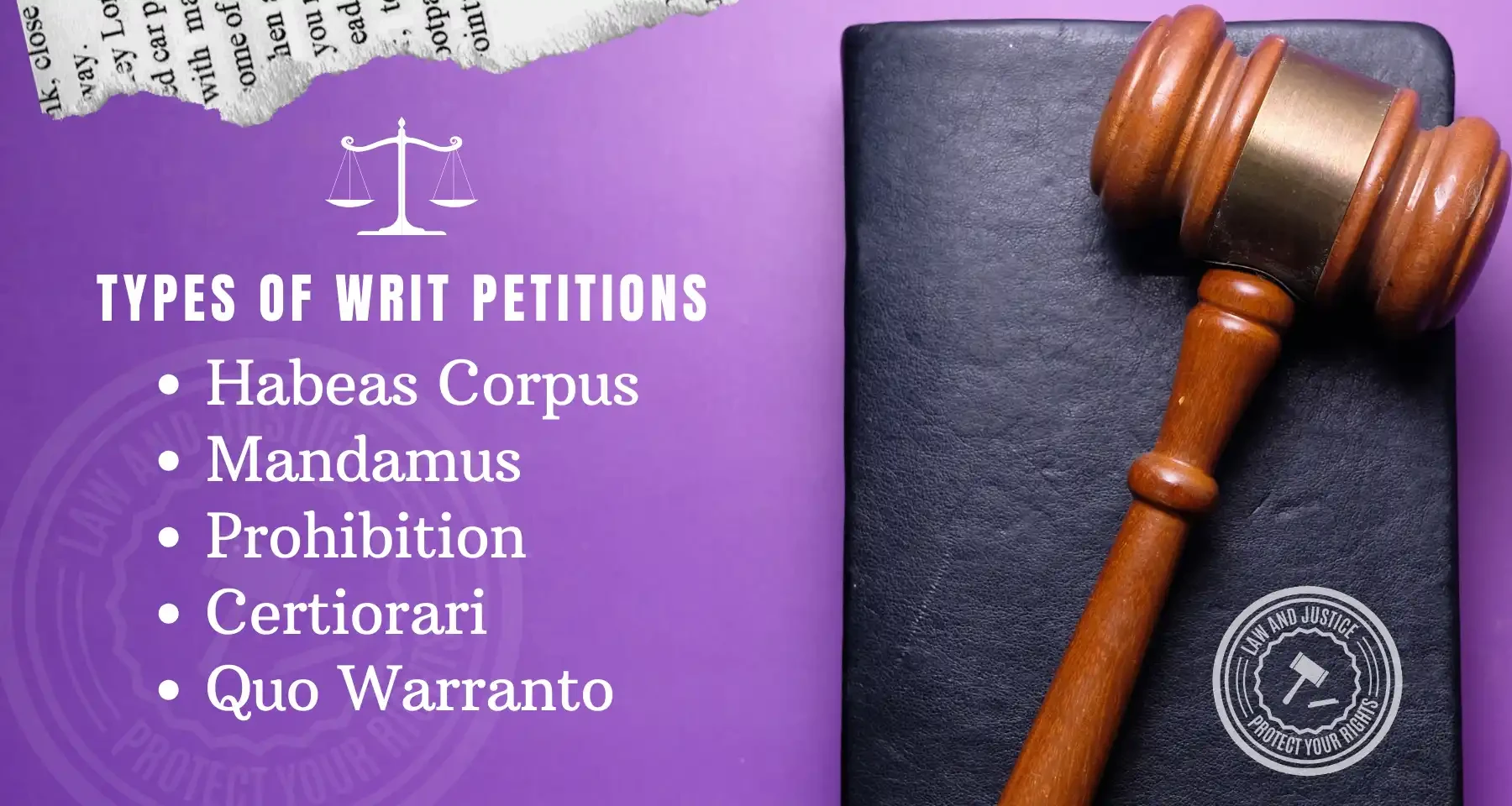
Writ Petition: Article 226 & 227 of Constitution Remedy in Criminal Cases Before the High Court
Quick Reference: Writ Remedies at a Glance
| Remedy | When to Use | Bench |
|---|---|---|
| Habeas Corpus | Illegal arrest or detention; remand without application of mind; detention beyond permissible period | Division Bench (Cri. W.P.) |
| Certiorari | Quash order of inferior court — jurisdictional error, error of law on face of record, violation of natural justice | Single Judge or Division Bench |
| Prohibition | Prevent inferior court from proceeding where it lacks jurisdiction | Single Judge or Division Bench |
| Mandamus | Compel a public authority to perform a statutory duty — e.g. register FIR, return seized property | Single Judge |
| Section 482 / 528 BNSS | Quash FIR, charge-sheet, or criminal proceedings — abuse of process, no offence disclosed | Single Judge (Cri. Application) |
Constitutional Foundation: Articles 226 and 227
Article 226 of the Constitution confers on every High Court the power to issue directions, orders, or writs — including writs in the nature of habeas corpus, mandamus, prohibition, quo warranto, and certiorari — to any person or authority, including the Government, within its territorial jurisdiction. This power is wider than that of the Supreme Court under Article 32, which is confined to enforcement of fundamental rights alone.
Article 227 vests in the High Court a supervisory jurisdiction over all courts and tribunals within its territory. Unlike Article 226, which is a writ jurisdiction, Article 227 is a superintendence power — it enables the High Court to call for records, examine the legality and propriety of proceedings, and correct jurisdictional errors without necessarily issuing a formal writ.
In criminal matters, both provisions are regularly invoked — often together — to challenge illegal arrests, quash FIRs and charge-sheets, challenge orders of remand, seek release from unlawful detention, and correct jurisdictional excesses by Magistrates and Sessions Courts.
Habeas Corpus: Challenging Illegal Detention
A writ of habeas corpus — literally "you shall have the body" — commands the detaining authority to produce the detained person before the court and justify the detention in law. It is the most ancient and most important writ for the protection of personal liberty.
In criminal matters, habeas corpus is maintainable where: (a) the arrest has been made without following the mandatory safeguards under Section 41B, 41D, or 50 of the CrPC / corresponding BNSS provisions; (b) the person is detained beyond the period permissible under Section 57 CrPC / BNSS without production before a Magistrate; (c) remand has been granted mechanically without application of mind; (d) the detention is under a provision that does not apply to the facts; or (e) the detaining authority lacks jurisdiction.
The Bombay High Court has consistently held that habeas corpus is not merely a remedy of last resort — it is available even where other remedies exist, if the detention is prima facie illegal. The court will not refuse the writ merely because a bail application is pending or could be filed.
Key procedural point: a habeas corpus petition is filed as a criminal writ petition (Cri. W.P.) and is ordinarily heard by a Division Bench. Urgent matters can be mentioned before the Chief Justice for out-of-turn listing.
Quashing of FIR and Charge-Sheet under Section 528 BNSS / 482 CrPC
Section 482 of the CrPC (now Section 528 of the BNSS, 2023) preserves the inherent power of the High Court to make such orders as are necessary to prevent abuse of the process of any court or to secure the ends of justice. This provision is the most frequently invoked in criminal writ practice.
The Supreme Court in State of Haryana v. Bhajan Lal (1992) laid down the categories of cases in which the High Court may quash an FIR: where the allegations in the FIR, even if taken at face value, do not disclose a cognisable offence; where the allegations are so absurd that no prudent person could ever reach a just conclusion that there is sufficient ground for proceeding; where the criminal proceeding is manifestly attended with mala fide intent; where the FIR is filed to wreak vengeance or to settle a civil dispute; and where a continuing criminal proceeding would amount to an abuse of process.
Post-BNSS, the position remains the same — Section 528 BNSS is the successor provision to Section 482 CrPC and carries identical language. The Bombay High Court has clarified that pending cases under the CrPC continue under the CrPC, while new cases filed after 1 July 2024 are governed by the BNSS.
Quashing of a charge-sheet is a higher threshold than quashing an FIR, because by the time a charge-sheet is filed, the investigating agency has applied its mind to the material. However, the power exists and is exercised where the charge-sheet discloses no offence, or where the continuation of the trial would be an abuse of process.
Writ as an Alternative to Anticipatory Bail
Where anticipatory bail under Section 438 CrPC / Section 482 BNSS is not available — because the offence is excluded from the scope of anticipatory bail, or because the Sessions Court has rejected the application and the High Court is approached — a writ petition under Article 226 may be filed seeking a direction that the petitioner shall not be arrested without prior notice, or that any arrest shall be subject to conditions.
This route is particularly relevant in cases under special statutes such as the NDPS Act, the PMLA, and the CGST Act, where the statutory scheme restricts or complicates anticipatory bail. The Bombay High Court has, in appropriate cases, granted interim protection against arrest by way of a writ even where anticipatory bail was not maintainable.
The distinction is important: a writ of protection against arrest is not the same as anticipatory bail. It operates as a direction to the State not to arrest without notice, giving the petitioner an opportunity to approach the court if arrest is imminent. It does not confer the same protection as a bail order, but it is a meaningful interim remedy.
In GST and FEMA matters, where the power of arrest vests in an officer rather than a court, the writ route is often the only available pre-arrest remedy. The Supreme Court in Radhika Agarwal v. Union of India (2025) confirmed that anticipatory bail is maintainable in GST cases on apprehension of arrest, and that the High Court's power under Article 226 is not ousted.
Certiorari and Prohibition: Correcting Jurisdictional Errors
A writ of certiorari lies to quash the order of an inferior court or tribunal where: (a) the court acted without jurisdiction; (b) the court exceeded its jurisdiction; (c) there is an error of law apparent on the face of the record; or (d) the principles of natural justice were violated.
In criminal matters, certiorari is used to challenge orders of remand, orders framing charges, orders rejecting discharge applications, and orders passed by Magistrates in cognisance matters. The High Court will not, however, use certiorari to conduct a mini-trial or re-appreciate evidence — the jurisdiction is supervisory, not appellate.
A writ of prohibition lies to prevent an inferior court from proceeding further in a matter where it lacks jurisdiction. It is a preventive writ, issued before the inferior court acts, unlike certiorari which is curative. In criminal practice, prohibition is used where a Magistrate is about to take cognisance of a matter over which it has no jurisdiction, or where a Special Court is proceeding in a matter that does not fall within its special jurisdiction.
Under Article 227, the High Court exercises a broader supervisory power — it can correct not only jurisdictional errors but also gross errors of procedure and perverse findings that no reasonable court could have arrived at. The distinction between Article 226 (certiorari) and Article 227 (supervisory jurisdiction) has been blurred in practice, and petitions are routinely filed under both provisions.
Interface with the BNSS, 2023
The Bharatiya Nagarik Suraksha Sanhita, 2023 (BNSS) replaced the Code of Criminal Procedure, 1973 with effect from 1 July 2024. The transition raises several questions in writ practice that are still being worked out by the courts.
Section 528 BNSS is the successor to Section 482 CrPC. The inherent power of the High Court is preserved in identical terms. Petitions filed under Section 482 CrPC in respect of proceedings that commenced before 1 July 2024 continue under the CrPC; new proceedings are governed by the BNSS.
The BNSS introduces several changes relevant to writ practice: (a) the period of police custody remand has been extended and can now be sought in tranches; (b) the provisions on bail have been restructured; (c) the BNSS introduces a new provision on bail in cases involving multiple offences; and (d) the BNSS contains new provisions on handcuffing and the use of force during arrest.
Practitioners should note that the Bombay High Court has issued administrative directions on the filing of petitions under the BNSS, and the cause title of petitions filed after 1 July 2024 should refer to the BNSS provision rather than the CrPC provision. However, the substantive law on writ jurisdiction — Articles 226 and 227 — is unchanged.
Drafting the Writ Petition: Key Elements
A criminal writ petition before the Bombay High Court must contain: (a) a concise statement of facts; (b) the grounds on which relief is sought, with specific reference to the constitutional provisions and statutory provisions relied upon; (c) the reliefs sought, including interim reliefs; and (d) a verification and affidavit.
The statement of facts should be precise and should not contain argument. The grounds should be numbered and should each identify a specific legal infirmity — jurisdictional error, violation of natural justice, error of law apparent on the face of the record, or abuse of process. Vague grounds such as "the order is illegal and arbitrary" without more are not sufficient.
For quashing petitions, the grounds must engage with the specific allegations in the FIR or charge-sheet and demonstrate why, even if those allegations are taken at face value, no offence is disclosed. The court will not look beyond the FIR at the investigation stage — the test is whether the FIR, read as a whole, discloses the ingredients of the offence alleged.
For habeas corpus petitions, the petition must identify the specific provision under which the detention is alleged to be illegal, and must annex the arrest memo, remand order, and any other relevant documents. The production of the detainee is ordered as a matter of course, and the matter is heard on the returnable date.
Interim Relief: Stay of Arrest and Protection Orders
Interim relief in criminal writ petitions takes several forms: (a) a stay of arrest — a direction that the petitioner shall not be arrested pending hearing of the petition; (b) a stay of further proceedings — a direction that the trial court or Magistrate shall not proceed further; (c) a direction for production — in habeas corpus matters, a direction to produce the detainee; and (d) a direction for release — where the detention is found to be prima facie illegal.
A stay of arrest is granted on a prima facie case that the FIR or the proposed arrest is illegal or an abuse of process. The court will also consider the balance of convenience and whether the grant of interim relief would cause prejudice to the investigation or prosecution.
In practice, the Bombay High Court grants ad interim relief on the date of filing in urgent matters, and the matter is then placed on the board for hearing on notice to the State. The State is ordinarily given two to four weeks to file its reply, and the matter is then heard on the returnable date.
Practitioners should note that a stay of arrest does not prevent the investigating agency from continuing the investigation — it only prevents the physical arrest of the petitioner. The petitioner remains obliged to cooperate with the investigation, and any non-cooperation may be a ground for vacation of the stay.
Key Precedents from the Bombay High Court and Supreme Court
State of Haryana v. Bhajan Lal (1992) 1 SCC 335: The locus classicus on quashing of FIRs — the seven categories of cases in which the High Court may exercise its power under Section 482 CrPC. Still the leading authority, applied uniformly by the Bombay High Court.
Arnab Ranjan Goswami v. Union of India (2020) 14 SCC 12: The Supreme Court reaffirmed that the High Court's power under Article 226 to protect personal liberty is not to be curtailed by procedural technicalities. The court must act when personal liberty is at stake.
Satender Kumar Antil v. CBI (2022) 10 SCC 51: On the right to default bail and the obligation of courts to inform accused persons of their rights. Relevant to habeas corpus petitions where default bail has not been granted.
Radhika Agarwal v. Union of India (2025): On the safeguards applicable to arrest under the CGST Act, the applicability of CrPC/BNSS provisions to GST arrests, and the maintainability of anticipatory bail in GST cases. Directly relevant to writ petitions in GST matters.
Gurbaksh Singh Sibbia v. State of Punjab (1980) 2 SCC 565: The foundational authority on anticipatory bail — the power is to be exercised with care but is not to be whittled down by judicial construction. Relevant where the writ route is used as an alternative to anticipatory bail.
Need to File a Writ Petition?
Our team regularly appears before the Bombay High Court in criminal writ matters — FIR quashing, habeas corpus, anticipatory bail alternatives, and supervisory jurisdiction petitions. Contact us for a consultation.